

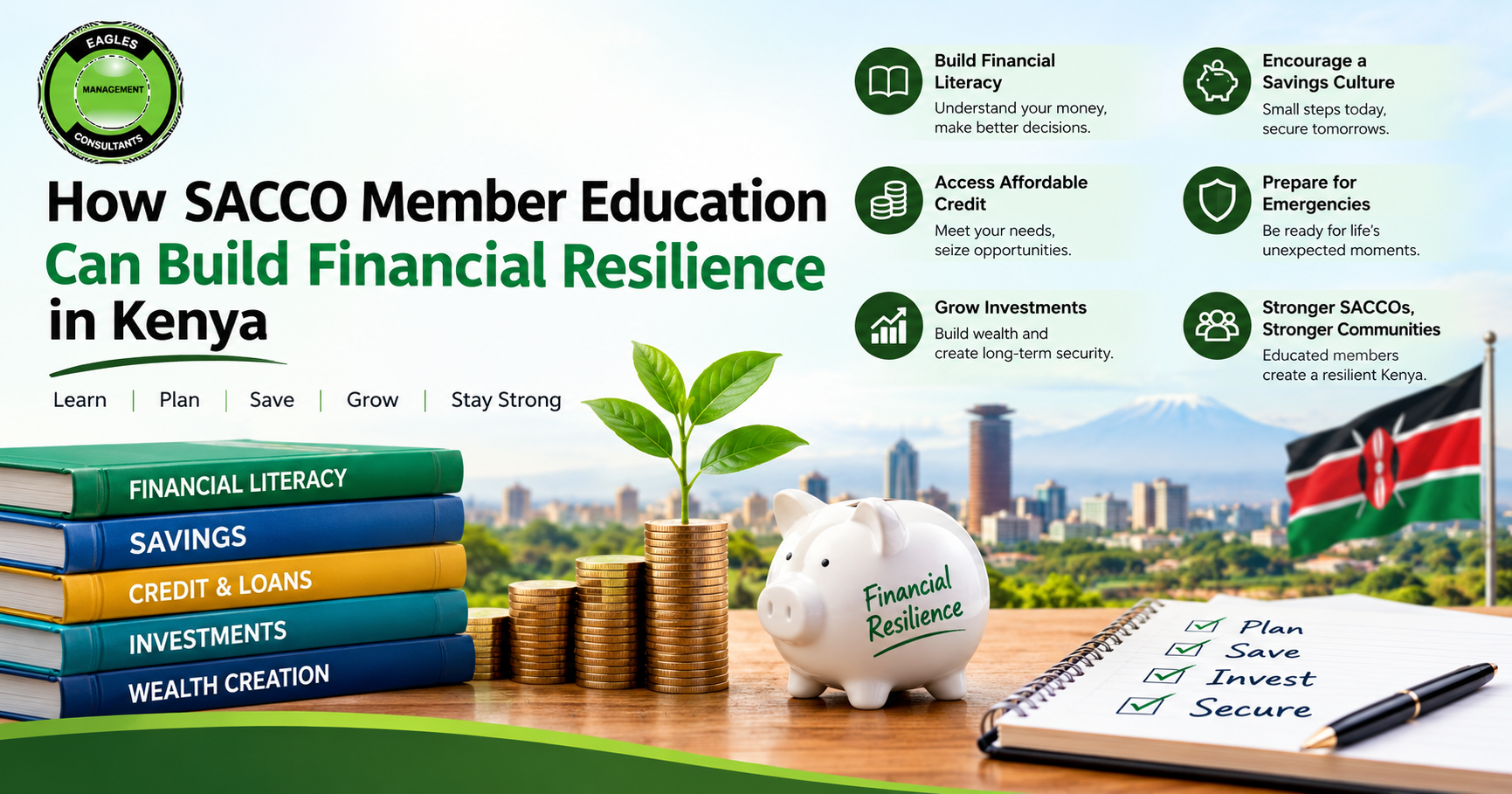
DON’T WAIT FOR THE BRIDGE TO COLLAPSE: WHY SACCO MEMBER EDUCATION MUST MOVE FROM LOANS TO WEALTH RESILIENCE.
A bridge can carry thousands of people safely for years and still collapse when the river rises beyond what its foundations were designed to withstand.
That is a warning Kenya’s SACCO movement should take seriously.
A SACCO may have growing deposits, a healthy loan book, rising membership and strong annual results. Yet beneath those numbers can be a significant vulnerability: members whose ability to earn, repay loans and maintain savings depends heavily on one employer, one industry, one crop, one market or one predictable economic environment. When that foundation is disrupted, the SACCO feels the impact.
The question is therefore no longer simply whether a SACCO is financially strong today. The more important question is:
Are its members economically resilient enough to remain financially strong when tomorrow looks completely different from today?
THE MEMBER EDUCATION GAP: HAVE WE TAUGHT BORROWING BETTER THAN WEALTH CREATION?
For years, SACCO member education has understandably focused on familiar areas such as savings, loans, interest rates, repayment discipline, dividends, AGM participation and SACCO performance.
These remain important. But they are not enough.
A member may know how to qualify for a development loan without understanding how to build a business capable of repaying that loan if employment is lost. A farmer may know how to access agricultural credit without knowing how to diversify crops, create additional income streams, add value to produce or protect the household when climate conditions change. An employee may faithfully repay a loan for many years without ever developing a second source of income.
This creates a dangerous paradox:
A SACCO can educate members to become better borrowers without sufficiently preparing them to become financially resilient wealth creators.
When income stops, the loan does not stop.
School fees remain due. Food still has to be purchased. Rent continues. Medical expenses arise. Business costs remain. The member may eventually seek additional borrowing simply to service existing debt.
That is not sustainable wealth creation.
It is financial fragility disguised as financial inclusion.
THE HIDDEN TIME BOMB: CONCENTRATED MEMBERS CREATE CONCENTRATED SACCO RISK.
Every SACCO should ask a difficult question:
What would happen to our loan book if the dominant source of our members’ income disappeared for six months?
Think about a SACCO whose members largely depend on one major employer, one industry, one agricultural activity, one local market or one source of economic activity. The SACCO may have thousands of members, but the economic exposure of those members could still be concentrated around the same risk.
If the employer closes, employees lose income. If a factory stops production, suppliers and traders lose customers. If floods destroy farms, farmers lose harvests. If drought affects livestock, pastoral households lose productive assets. If economic disruption affects supply chains, businesses dependent on imported products or particular markets can experience sudden losses.
The effects can quickly move into the SACCO:
Reduced deposits. Delayed repayments. Rising arrears. Loan restructuring. Increased liquidity pressure. Deteriorating asset quality.
This is why member diversification should be viewed as more than a personal-development issue.
It is part of SACCO risk management.
KAJIADO AND THE ECONOMIC RESILIENCE WAKE-UP CALL.
Kajiado provides a useful illustration of how economic concentration and external shocks can converge.
THE TATA CHEMICALS MAGADI SHOCK.
Tata Chemicals Magadi’s operations have faced disruption amid a regulatory dispute, creating uncertainty for employees, communities and businesses connected to the operation.
The broader lesson for SACCOs is bigger than the dispute itself.
A dominant economic activity can appear permanent until suddenly it is not.
Where households, businesses and SACCO members depend heavily on one employer or industry, disruption can move rapidly through the local economy.
Employees reduce spending. Suppliers lose customers. Small businesses experience declining turnover. Loan repayments become harder. Savings may be withdrawn to meet immediate household needs. A SACCO that has prepared only for normal economic conditions can quickly find itself dealing with abnormal credit risk.
THE CLIMATE QUESTION.
Climate volatility makes the concentration problem even more important. Farmers, pastoralists, traders and other small producers can be particularly vulnerable to drought, flooding, excessive rainfall and other climate-related disruptions.
Consider a SACCO member whose livelihood depends entirely on farming. A flood destroys the crop. Drought reduces livestock. A damaged road prevents access to the market.
At the same time, another member may depend on a single employer whose operations have suddenly been suspended.
Different shocks. Same consequence: income interruption—and therefore repayment risk.
That is the bridge SACCOs must reinforce before the river rises.
DIVERSIFICATION IS NO LONGER A NICE-TO-HAVE—IT IS SURVIVAL.
SACCO member education needs to evolve from:
“How do you get a loan?”
to:
“What will make you financially stronger five years from now?”
Members need practical skills that help them build, protect and diversify their income.
1. ENTREPRENEURSHIP.
Members should understand how to identify viable opportunities, evaluate business ideas, price products, manage cash flow and understand customer needs. The objective should not simply be to encourage members to start businesses. It should be to help them build sustainable businesses.
2. AGRIPRENEURSHIP.
Agricultural members need more than access to credit. They need knowledge on commercial farming, value addition, market access, diversification, climate-smart practices and better farm economics. A stronger agricultural enterprise creates a stronger income base and improves the member’s ability to manage financial obligations.
3. MULTIPLE INCOME STREAMS.
A salary should not necessarily be the household’s only economic engine. Members can be encouraged to responsibly explore additional income through businesses, investments, professional services and productive assets. Multiple income streams can provide a buffer when one source is disrupted.
4. BUSINESS SKILLS AND MANAGEMENT.
Access to capital does not automatically create a successful business.
Members need practical skills in:
- Bookkeeping
- Cash-flow management
- Inventory control
- Pricing
- Tax compliance
- Working-capital management
- Separating business finances from household finances
A loan can provide capital. It cannot provide business discipline.
5. DEBT AND LOANS MANAGEMENT.
Members need to understand productive borrowing, debt-service capacity, loan stacking, refinancing risks and responsible repayment. They should also understand the importance of seeking assistance early when repayment difficulties emerge rather than waiting until the situation becomes critical.
6. FINANCIAL WELLNESS.
Financial resilience includes more than earning money. Members also need skills in household budgeting, emergency planning, saving, investment decisions, insurance awareness and preparing for income interruptions.
7. MENTAL HEALTH AND WELLNESS.
Financial pressure can affect decision-making, relationships, productivity and overall wellbeing. Job loss, business failure and debt can create significant emotional pressure. Financial education should therefore be complemented by wellness programs that help members build the capacity to cope with uncertainty and recover from setbacks.
8. CAREER TRANSITIONS.
Industries change. Technology changes. Organizations restructure. Members should be encouraged to develop transferable skills and prepare for career transitions before redundancy or major disruption occurs.
These are not soft extras.
They are economic shock absorbers.
RESILIENT MEMBERS BUILD STRONGER SACCOs.
The connection between member resilience and SACCO resilience is direct. A financially diversified member is better positioned to continue meeting financial obligations when one income source is disrupted. A member with a viable business may have an alternative repayment engine when employment changes.
A farmer with better commercial and climate-resilient practices can better protect productive assets. A financially literate borrower is more likely to assess debt carefully before taking on new obligations. A member who understands debt management is more likely to seek assistance before arrears become chronic. A member equipped to manage career and financial pressure may also be better positioned to make rational decisions during a crisis.
Therefore:
Member resilience becomes SACCO resilience.
SACCO boards and management should begin viewing member education as part of long-term institutional sustainability and credit-risk management.
Instead of measuring member education only by attendance numbers, SACCOs should ask:
- How many members have developed additional income streams?
- How many businesses started with SACCO loans are still operating successfully?
- How many agricultural borrowers have diversified their livelihoods?
- How many members understand their debt-service capacity?
- How many members have emergency financial plans?
- How exposed is the membership to one employer, industry, crop or geographic economy?
These questions move member education from the classroom into the real economy.
THE ROLE OF PROFESSIONAL SACCO TRAINING.
Building financially resilient members requires more than occasional seminars. SACCOs need practical, relevant and well-structured training programs that connect financial education with real-world decision-making.
This is where Eagles Management Consultants can support SACCOs.
Eagles Management Consultants provides professional training and consulting programmes designed to help organizations, teams and people improve effectiveness and achieve sustainable results. Its services include SACCO training, financial skills, staff wellness, personal development, leadership and management programs, among other organizational development solutions.
Rather than treating member education as a once-a-year activity, SACCOs can make it part of a broader strategy for building financially informed, productive and resilient members.
SACCO MEMBER EDUCATION TRAINING PROGRAMS.
Eagles Management Consultants can support SACCOs with practical programs covering areas such as:
1. Financial Wellness.
Helping members make better financial decisions, strengthen household financial management and prepare for unexpected financial pressures.
2. Entrepreneurship.
Helping members turn ideas into sustainable income-generating enterprises.
3. Business Skills and Management.
Equipping members with practical skills for running businesses more effectively and responsibly.
4. Agripreneurship.
Helping agricultural members develop commercially focused and diversified income-generating activities.
5. Mental Health and Wellness.
Supporting members and employees in managing stress, uncertainty, financial pressure and workplace challenges.
6. Career Transitions.
Preparing members to respond to changing industries, redundancy, career changes and emerging opportunities.
7. Debt and Loans Management.
Helping members understand responsible borrowing, manage existing debt and make better credit decisions.
These programs can complement the wider SACCO management and training support offered by Eagles Management Consultants.
THE CALL TO ACTION: BUILD MEMBERS WHO CAN SURVIVE THE STORM.
The SACCO of the future cannot simply be a place where members save and borrow. It must become a platform where members learn, build, diversify, protect and grow wealth.
The strongest SACCO is not necessarily the one with the biggest loan book.
It is the one whose members can continue earning, creating wealth and meeting their financial obligations—even when the economic environment changes dramatically.
For SACCO boards, management teams and member-education committees, the message is simple:
Don’t wait for the bridge to collapse before teaching members how to survive the flood. Invest in member education before the crisis. Build resilience before the disruption. Prepare members before their income is threatened. Because when members become stronger, the SACCO becomes stronger.
EAGLES MANAGEMENT CONSULTANTS.
Empowering people. Strengthening teams. Improving organizational performance.
For SACCO training, financial skills, wellness, leadership, personal development and other professional training programs, visit:
Phone: 0722 114 865 / 0723 291 402
Email: info@eaglesconsultants.com
Eagles Management Consultants is based in Nairobi and serves organizations, corporates, NGOs, SACCOs and government agencies with professional training and consulting solutions.